There was once a time when simply earning a college degree could land students a job following graduation. Though there are a handful of professions that offer a pipeline from college to career, these jobs are few and far between. With that being said, remember: Regardless of the major you choose or the degree you earn, career preparation should remain at the forefront of every student’s mind from the day you start looking for colleges to the day you accept a postgrad job offer. Need more convincing? Here’s what you should know about the importance of career prep.
Why do students go to college?
Students may opt to apply to college because it’s what’s expected of them after high school; to pursue their dream job; to get away from home; to become associated with a “top” school; and/or to make their family proud. The reasons vary and are highly individual, but the vast majority of students pursue college to become qualified for a good job—especially if they have a career path in mind that makes them excited—and make a decent living.
According to Carnegies's College Choice Trends, the top three reasons students decide to go to college among the reasons listed in the survey were:
- Scholarships & Financial Aid (51%)
- Tuition Price (46%)
- Degree Options (45%)
This is based on more than 3,400 prospective students and parents, and the data backs these ambitions:
- In 2024, the unemployment rate for Americans with a bachelor’s degree was 2.2%, according to the U.S. Bureau of Labor Statistics. In contrast, Americans with a high school diploma had an unemployment rate of 4.2%, nearly double that of bachelor’s degree holders.
- College graduates have significantly higher earning potential than people whose highest level of education is a high school diploma. According to the U.S. Bureau of Labor Statistics (2024), workers with a bachelor’s degree earned a median of $1,543 per week, while those with a high school diploma earned $930 per week.
- Bachelor’s degree holders ages 25–34 earned a median income of around $66,600 in 2022, while their peers without college degrees earned $41,800—a gap of about 59%, according to the National Center for Education Statistics.
However, a degree in hand does not guarantee a job post-graduation. Things have changed drastically over the last several decades, and gone are the days of a degree opening doors without additional effort and consideration.
Related: Top 10 Career Fields in America: What You Should Know
Misconceptions about college and careers
Students and parents have many beliefs about what a college degree can bring, and some of those beliefs are no longer accurate in today’s competitive job market. But one incredibly common misconception seems to stand above the rest:
“All that college graduates need to be marketable to employers is a college degree...especially if that degree is from a reputable college.”
Unfortunately, that’s simply not the case anymore. “The fact of the matter is that the college graduate job market is very different now than it was 10 or 20 years ago,” said Mark Schappert, a University Employer Relations Partner and College-to-Career Consultant. “Even though overall employment levels were very high going into this past spring, a surprising number of college graduates have been struggling for the last decade to launch and land professional entry-level jobs.”
How the weight of a college degree has decreased
Years ago, higher education used to be considered more of a privilege than a logical next step. Now, more students than ever are earning a four‑year degree—and as a result, there are more college graduates than there are skilled entry‑level jobs. Employment in professional and technical occupations has expanded significantly, rising from 30.2 million in 2000 to 93 million in 2023, according to an analysis of U.S. Bureau of Labor Statistics data by the Department for Professional Employees. College completion rates have also continued their long-term rise: between 1940 and 2022, the share of Americans ages 25 and older with a bachelor’s degree or higher increased from 4.6% to 38.3%, according to the National Center for Education Statistics. In fact, as of Q3 2025, about.8% of recent college graduates were underemployed, according to data from the Federal Reserve Bank of New York.
One of the contributing factors to underemployment is the rise in jobs that “prefer” or require a college degree, a trend often called degree inflation or credential inflation. At the same time, young college graduates are struggling to find roles that fully use their education.
What students need to do to graduate college career-ready
“These days, a career-ready college graduate needs a degree...plus a little extra,” says Schappert. Four elements are crucial to becoming a well-rounded, career-ready job candidate after graduation:
- Job hunt and career field smarts: Basic job search–related skills (search strategies, résumé writing, interviewing) in addition to field awareness, knowledge, and interest
- Experiences outside of the classroom: Internships, co-ops, projects, volunteering, extracurricular activities
- A professional network: You know what they say: It’s not what you know—it’s who you know.
- Both soft and hard skills that align with career interests: Oral communication, teamwork, critical thinking, and industry-specific technology skills
In addition to developing these, successful college-to-career launchers begin thinking about and planning for careers early in college, are proactive in taking control of their career preparation, and use the abundance of resources available to them (college career services are there for a reason!).
Related: Boost Your Career Advantages With These Five Liberal Arts Skills
The role of counselors in career prep
One of the many valuable resources available to high school and college students is counseling services. Though high school counselors can help with a student’s transition to college, they often have limited time and varying levels of expertise when it comes to career preparation. Fortunately, college counselors—particularly those in the career services department—can be incredibly helpful (when they have the time).
Utilizing career services in college
According to the 2023 Student Voice survey reported by Inside Higher Ed, about one‑third of college students—including many nearing graduation—have never interacted with their campus career center. Among those who do, the largest share—about four in ten—engage only two to five times, and students often gravitate toward lower‑impact services rather than the advising and career‑planning support they say they value most. The survey also highlights a clear mismatch between what students want from career services and what they actually seek out, especially when it comes to guidance on internships, job searches, and career pathways. If we could offer just one piece of advice: be proactive and make full use of your college or university’s career services—especially the high‑value advising that can meaningfully shape your post‑graduation success.
Hiring a private college or career consultant
Hiring a professional can be a smart move if free career services and resources available to you aren’t “doing the trick.”
- College consultants can help you identify schools that are a good match for your academic strengths and interests, advise on crafting strong applications, and assist in maximizing financial aid.
- Private career consultants or coaches can help you target careers that are a good fit for your skills and areas of interest, strongly prepare to launch a career upon graduation, and develop and execute an individualized college-to-career plan.
Related: Eight Reasons to Use the Career Center Before Senior Year
Next steps
In order to truly prepare for today’s competitive job market, you must commit not only to earning a college degree but proactively preparing for your desired career path(s) throughout your college years. A few final tips:
- Learn as much about yourself as you can and find a few career paths that interest you.
- Explore and learn about various career options that could be a good fit for your skills and interests.
- Don’t stop after choosing a major—get granular about what specialty or concentration of that broad academic category you want to pursue.
- Focus on becoming strongly prepared and ready to launch your career upon graduation.
Download our free Career Prep Worksheet!
To get you started, we’ve created this free-to-download Career Prep Worksheet. It’s a PDF, so you can print it out or fill it out on a desktop computer. The second page is meant to be an in-depth exploration of a certain career field that can be duplicated or printed multiple times—one for each of your areas of interest. You can also print the third page as many times as needed to track each internship you complete throughout your high school and college career.

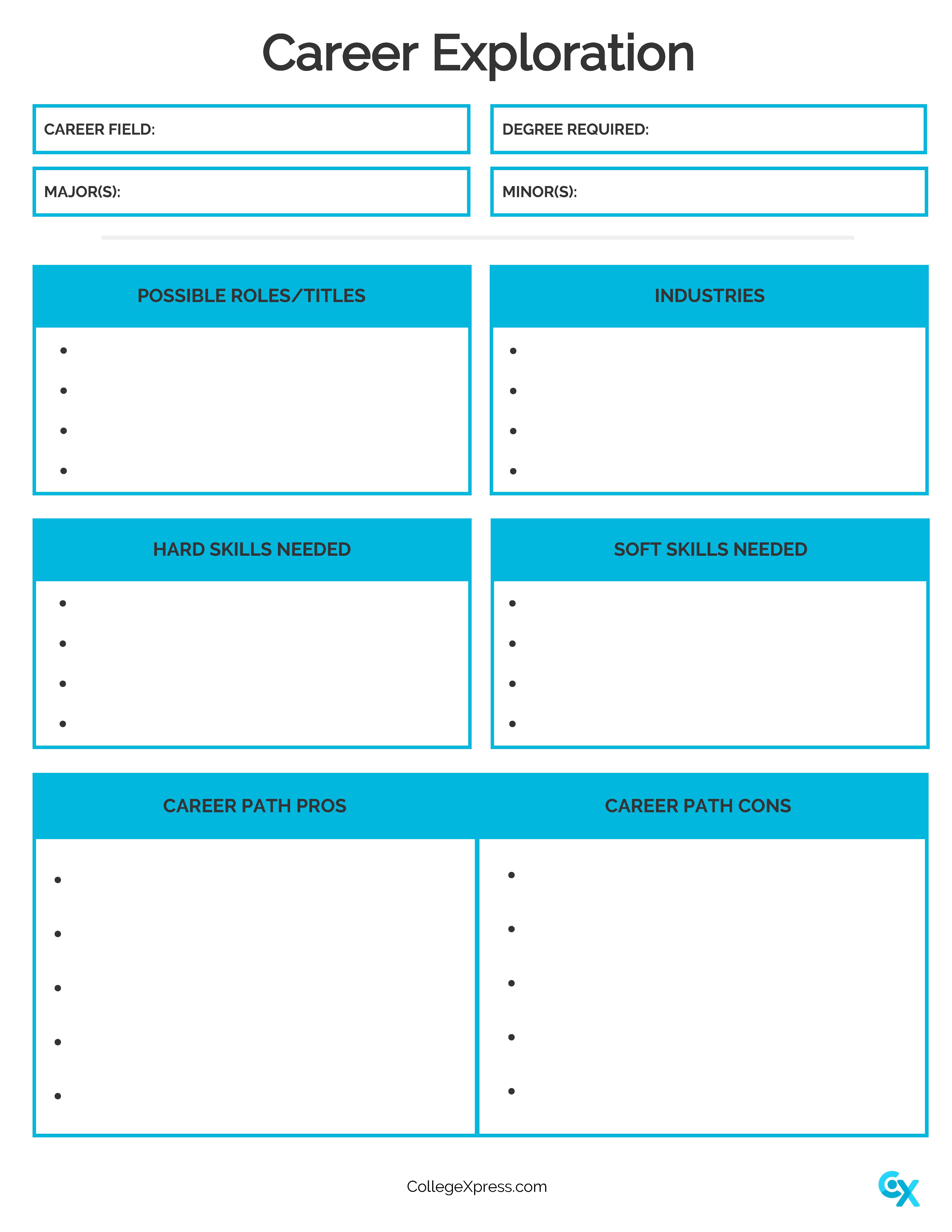
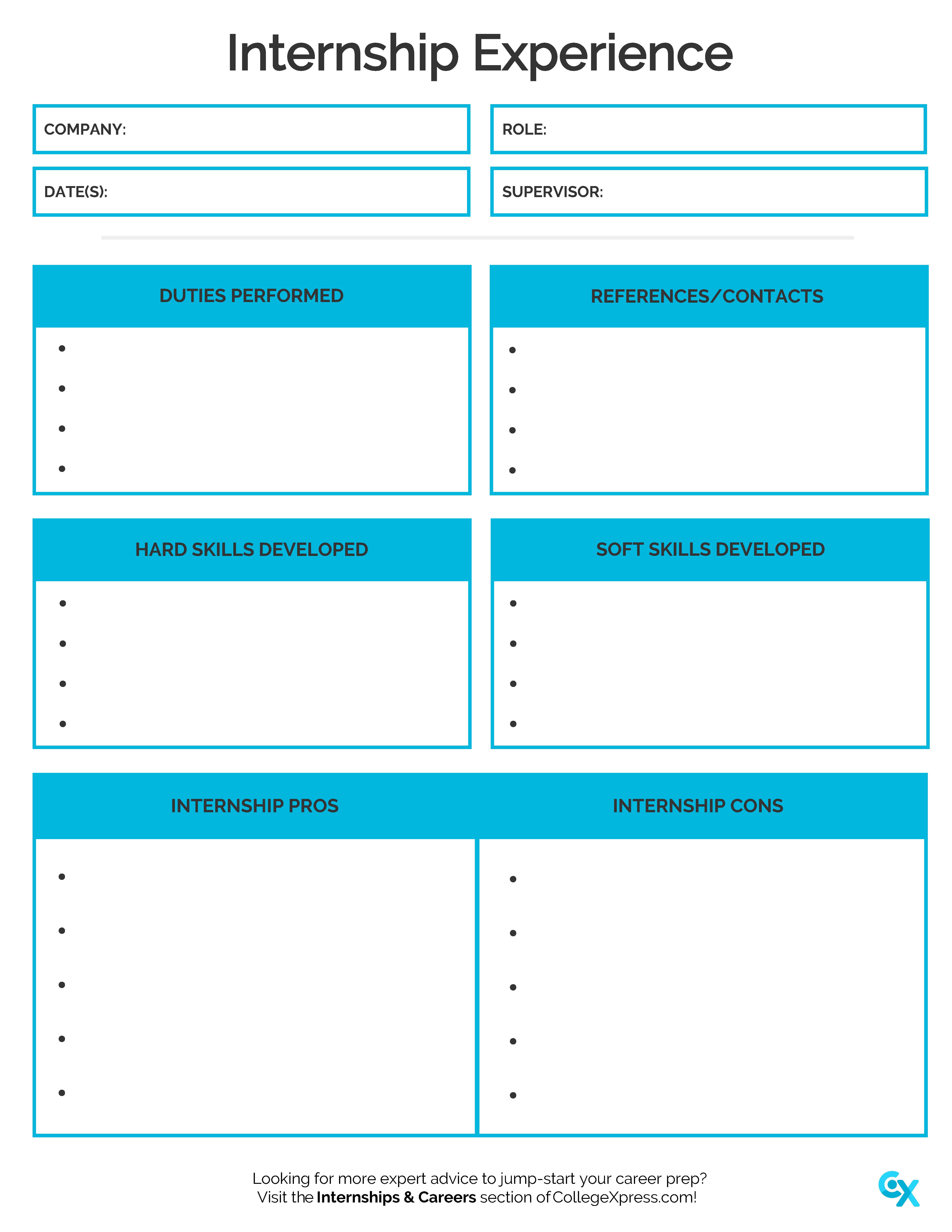
* To download our worksheet, you'll need to create a free CollegeXpress account. Once you're logged in, either click the images above or the link below to open the worksheet in a new window. From there, choose the download button or choose "File" then "Save as..." in your browser's main menu. Happy career planning!
Download the free career prep worksheet now, and find more information on different paths in our Internships and Careers section!